
Short answer: the Datejust shows the date only and comes in steel, two-tone Rolesor and gold, in 31, 36 and 41 mm. The Day-Date shows the day of the week spelled out in full as well as the date. It is made only in 18k gold or platinum, in 36 and 40 mm, and is usually worn on the President bracelet. Choose the Datejust for versatility and value, and the Day-Date if you want Rolex’s most prestigious dress watch.
Both watches share the same Oyster case, fluted bezels and Cyclops date lens, so they can look alike at first glance. The differences are in the metal, the dial, the bracelet and the price. This guide compares them side by side.
Datejust vs Day-Date at a glance
| Rolex Datejust | Rolex Day-Date | |
|---|---|---|
| Introduced | 1945 | 1956 |
| Display | Date at 3 o’clock | Day of the week at 12 o’clock and date at 3 o’clock |
| Current sizes | 31, 36 and 41 mm | 36 and 40 mm |
| Metals | Oystersteel, Rolesor (steel and gold) and some gold versions | 18k yellow, white or Everose gold, or platinum only |
| Signature bracelet | Jubilee (created for the Datejust) or Oyster | President (created for the Day-Date) |
| Current movement | Calibre 3235 (2236 in the 31 mm) | Calibre 3255 |
| Power reserve | About 70 hours (55 in the 31 mm) | About 70 hours |
| Nickname | — | “The President” |
1. The dial: date only, or day and date
Launched in 1945, the Datejust was the first self-winding chronometer wristwatch to show the date in a window on the dial. In 1956 Rolex went further with the Day-Date, the first wristwatch to show the day of the week spelled out in full, in an arc-shaped window at 12 o’clock. Rolex offers the day in a choice of languages. If you like the look of that extra window, only the Rolex Day-Date has it.
2. The metal: the biggest difference
The Day-Date has only ever been made in precious metals: 18k gold or platinum. The Datejust is mostly made in steel or Rolesor, Rolex’s name for steel combined with gold. This is why a Day-Date feels heavier on the wrist and costs much more. A steel Datejust is the easier everyday watch; a two-tone Datejust gives you the gold look for far less than a solid-gold Day-Date.
3. The bracelet: Jubilee and Oyster vs President
The five-link Jubilee bracelet was created for the Datejust in 1945, and the sportier three-link Oyster is also offered. The semi-circular three-link President bracelet was created for the Day-Date in 1956. It is reserved for gold and platinum Rolex models, and it gave the Day-Date its nickname. That is why a presidential Rolex watch usually means a Day-Date.
4. The sizes
The Datejust offers more choice: 31 mm for smaller wrists, the classic 36 mm, and 41 mm for a larger, more modern look. The Day-Date comes in 36 mm, the traditional size, and 40 mm, introduced in 2015. Between 2008 and 2015 Rolex also made a 41 mm Day-Date II.
5. The movement and generations
Current models use Rolex’s newest movements with about 70 hours of power reserve: calibre 3235 in the Datejust 36 and 41, and calibre 3255 in the Day-Date 40 (2015) and the updated Day-Date 36 (2019). Earlier models use calibres 3135 (Datejust) and 3155 (Day-Date), with about 48 hours of power reserve. Both earlier movements are highly reliable, and pre-owned watches with them are often much better value.
Vintage five-digit references are the most affordable way into either model. For example, the Day-Date 18238 was made from the late 1980s, has a sapphire crystal and a “double quickset” movement that lets you set the day and date separately. Learn how to read these numbers in watch reference numbers explained.
6. The price
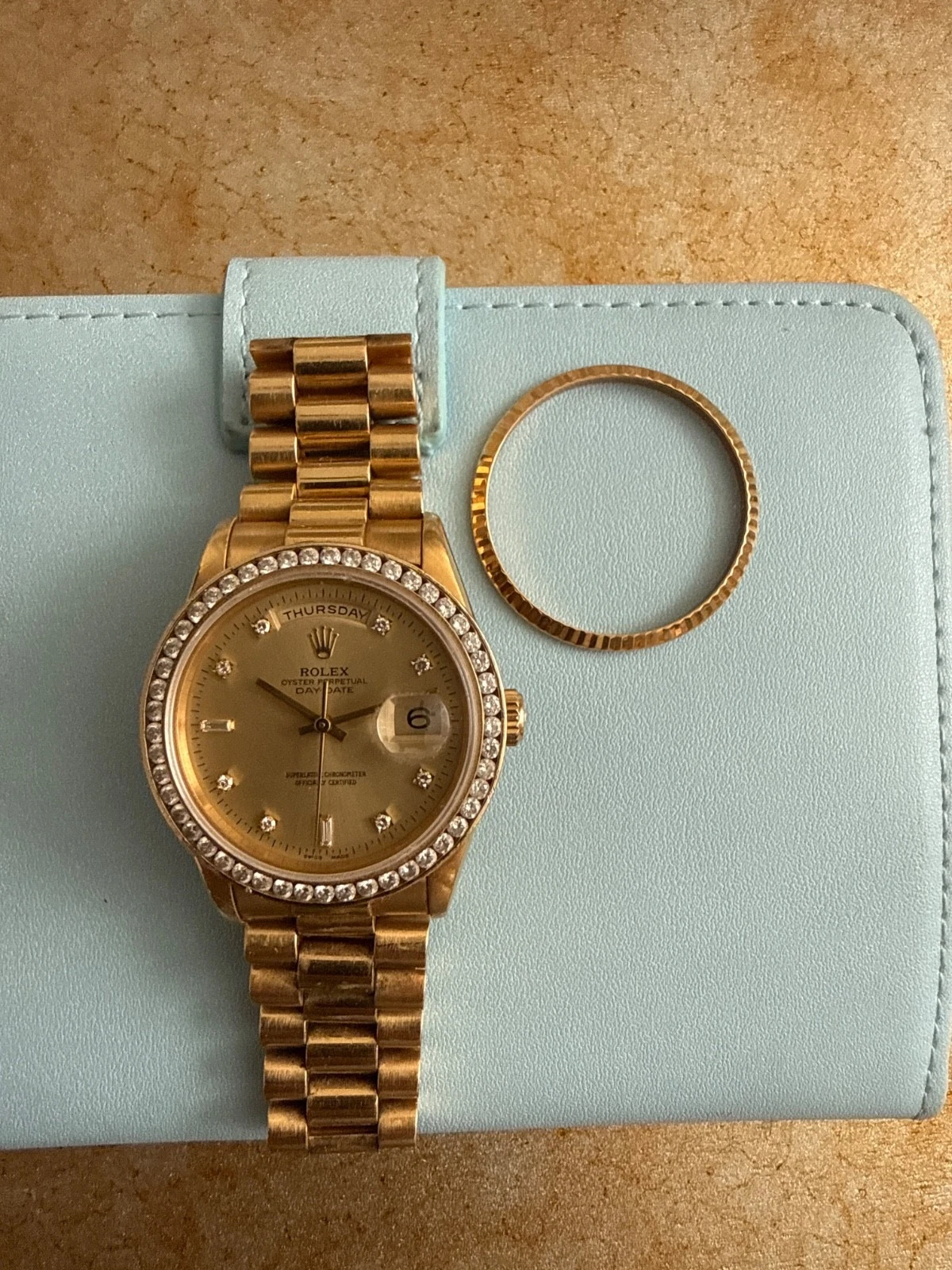
Because it is always solid gold or platinum, a Day-Date costs several times as much as a comparable steel Datejust when bought new. On the pre-owned market the gap narrows. In our current collection, Datejusts range from about $3,100 for a vintage two-tone 16013 to $11,800 for a modern 126234 or 126333, while our 18k yellow gold Day-Date 18238 with diamonds is $14,300.
Which should you buy?
- Choose the Datejust if you want one watch for every day, prefer steel or two-tone, want more size options, or have a smaller budget.
- Choose the Day-Date if you want solid gold or platinum, love the full day display and the President bracelet, and want Rolex’s most prestigious dress watch.
Rolex Day-Date and Datejust watches in our collection
- Rolex Day-Date 36, Ref. 18238: 18k yellow gold, champagne diamond dial, diamond bezel and President bracelet, 1990.
- Rolex Datejust 41, Ref. 126333: current generation, Yellow Rolesor with a fluted gold bezel.
- Rolex Datejust 36, Ref. 126234: current generation, mother-of-pearl diamond dial, full set.
- Rolex Datejust 36, Ref. 116200: all steel with a blue dial.
- Rolex Datejust 36, Ref. 16013: vintage two-tone with a chocolate dial.
Want more detail on sizes, bezels and dials? Read our Rolex Datejust buying guide, or see all Rolex watches.
What to check before buying
- The reference and serial match the papers, if papers are included.
- The movement matches the reference: calibre 3255 in a current Day-Date, 3155 in a 18xxx or 118xxx Day-Date.
- The day and date change cleanly around midnight and the day disc is aligned in its window.
- Gold cases and bracelets are not over-polished, and the President bracelet is not badly stretched.
- Service history, especially on vintage models.
Rolex’s own five-year warranty applies to watches sold new by official Rolex retailers. Every Rolex we sell is authenticated, shipped fully insured with signature on delivery, and covered by our 1-year Aurevorn warranty and 14-day return window. Questions? Email info@aurevornwatches.com, call +1 (701) 410-3828 or message us on WhatsApp.
Frequently asked questions
What is the difference between the Rolex Datejust and Day-Date?
The Datejust shows the date only and is made in steel, Rolesor and some gold versions in 31, 36 and 41 mm. The Day-Date also shows the day of the week spelled out in full and is made only in 18k gold or platinum, in 36 and 40 mm.
Why is the Rolex Day-Date called the President?
The Day-Date was launched in 1956 with the President bracelet, which was created for it and is reserved for gold and platinum Rolex models. The name became the watch’s nickname.
Is the Day-Date more expensive than the Datejust?
Yes. Because it is always made of solid gold or platinum, a new Day-Date costs several times as much as a comparable steel Datejust. Pre-owned and vintage Day-Dates narrow the gap.
Can you get a Datejust on a President bracelet?
The President bracelet is reserved for solid gold and platinum Rolex models, so it appears on gold Datejusts but not on steel or two-tone Rolesor versions, which use the Jubilee or Oyster bracelet.
Which is better, the Datejust or the Day-Date?
Neither is better; they suit different buyers. The Datejust is the more versatile everyday watch with more sizes and metals. The Day-Date is Rolex’s most prestigious dress watch, always in precious metal.



 No products in the cart.